My teaching inquiry will have quite a few contributing anchors this year.
1. Registered Teaching Criteria
1. Registered Teaching Criteria
The segment of change I will be focussing on is 'Cultural'
The impact of teaching / learning for diversity and Digital fluency


I've taken a while to start writing my inquiry because, actually it's exactly like last years!
Inspired by a workshop I went to run by Jennifer Garvey-Burger
One of the writers of Simple Habits for Complex Times.
There was a slide that I have been constantly thinking about.

I spent all of 2015 looking at the gaps - in student learning.
So, the one difference for my Inquiry this year is, I will not be singularly focussed on the 'gap in learning.' Instead, I will be attempting to focus on the 'system of learning' and how this impacts on the student's learning.
I'm going to try and do this by looking at the bigger picture of what is going on for the students. To look at the bigger picture I am going to use data from Positive Behaviour For Learning. (PB4L) To look at student/class behaviours and student / class academic achievement.
At the start of April I attended a PB4L Tier 1 and 2 workshop. Our facilitator asked us:
"How can we set up the student to fail? then try the opposite."
I instantly knew I had to give this a go.
I am also going to work on something about my self.
I am going to attempt to listen to learn rather than convince. I want to see if its possible to listen to my students in a new way.
The idea of listening differently has come from Jennifer Garvey-Burger.
I am reminded of John Hagel's words:
"In order to make a big impact, you need to think about small moves, smartly made. That means three things. Focus, leverage and acceleration.
Focus = sense of destination and direction.
Leverage = convincing others to contribute more energy than you have alone.
Acceleration = taking time for reflection, learning, and refinement to optimise for non-linear improvement."
John Hagel
So here goes trying something a little bit different.
I will be adding to this post over the next few weeks and writing throughout the year.
Watch this space! (as you can see - I have data to transfer!)
Planning to Achieve
| |||||||
Strategic Goals
| |||||||
Annual Goal
Achievement targets are set for groups of learners based on robust achievement information.
|
Annual Target Where do we want to be at the end of 2016?
Māori and Asian boys who are currently not achieving the writing standard for their year level will make above average progress towards achieving the standard in 2016.
Above average progress will be assessed by moving 2 sub levels within 6 months. | ||||||
Baseline data
| |||||||
Name
|
Reading
running record & or STAR results |
Asttle
range in results
Writing
|
Spelling
Peters & Pseudo |
NS – teacher OTJs
Reading & Writing |
observations
| ||
Student 1
HA
| T1: 3P T2: 3A | enjoying writing onto his digital portfolio. Seeks assistance form teacher when required. | |||||
Student 3
NB
| T1: 3A T2: 4B |
T1:Refuses to read. will read car manuals!
T2: During 1:1 reading. Recognising difference sentence structures and able to discuss their impact on the story. | |||||
Student 4
OC
|
T1: 3B
T2: |
T1: Negative about writing ability
T2: wanting to get to mid day writers | |||||
| Student 5 PD | T1: 3P T2: 3A | T1: Quiet in class T2: Seeking learning conversations with the teacher. | |||||
| Student 6 TE | T1: 3B T2: 3B | Increasing independence in classroom routines. Is able to tell support teachers what he is working on and why. Excited about his learning. | |||||
| Student 7 ZF Student 8 EG | T1: 3A T2: 4B T1:2B T2: 2P | ZF: T1: always keen to write. T2:Has started reading for leisure! EG: T1/T2seeks assistance from peers& teacher | |||||
Notes:
| |||||||
Key Improvement Strategies
What will you do to make sure that these boys make above average progress in writing this year?
3x a week 12:00 - 12:30pm Students will be part of a wiring program called Mid Day writers. 1:7 student teacher ratio. This is extra writing milage and instruction. | |||||||
Describe the aspects of your whole class programme that will promote learning for this group.
|
T1: Starting Book Selling
T1: Use of GAFE
T1:Use of youtube clips for repeated instructions
T1: Daily reading
T1: Publish onto their digital portfolio. Share portfolio with
T2: Students will attend an intensive writing group 1:7 teacher / student ratio 3x a week 'Mid Day Writers Guild' T2: 1:1 Reading with NB | ||||||
Spelling:
Will instruction in learning to spell help these boys improve their writing?
What will you do to
|
* Al the boys need to be using the right click function on their devices
* Discuss with students families to start using Word Q. Down load not their own devices. T2: Explore use of spellodrome | ||||||
Reading:
How will your Reading programme support these boys to achieve success in writing?
|
Reading for pleasure
T2: Students joining the Eggspedition program See link to Reading Eggs See link to Reading Eggsonline event T2: constantly recheckin library cards / access to Wellington Central Library - issuing of books. T2: Sharp Reading | ||||||
Goals:
Do these boys have personal goals for writing?
|
List goals here
See writing Goals on eAsttle - these are cut out and stuck on their books and laptop key boards.
HA Paragraph writing. Topic Sentence
KB Paragraph writing. Topic Sentence
OC Paragraph writing. Topic Sentence
PD Paragraph writing. Topic Sentence
TE Paragraph writing. Topic Sentence
ZF Paragraph writing. Topic Sentence
EG Paragraph writing. Topic Sentence
| ||||||
Other notes:
| |||||||
Resources
What do you need to be successful in raising the achievement level of this group of boys?
Reading books that capture the students interest. Mirror texts. Text that reflect the students world.
Explicit planning, that collects qualitative and quantitative data. | |||||||
So I start on my spiral of inquiry journey...
Term 1
Scanning. Scanning constantly knowing the gaps. Wondering how I can nudge the learning system.
Similar to last year, the students I am focussing on are quiet in class. Thanks to @BeccaSweeney 's comments in my 2015 Inquiry. I'm going to talk to the students and ask them why they are quiet in class and what things do they think might help them improve in their writing.
Student suggestions that might help them improve in their writing.
1. Have instructions written on the board.
2. Talk to the teacher 1:1 - not in a big or small group
3. Have more time to finish
4. Work with a friend.
5. Work in a small group on ideas for writing.
Why students think they are quiet in class.
1. Other students always ask the things they are thinking.
2. They put their hand up some times but teacher runs out of time to answer or does not see.
3. They have nothing to say.
4. Teacher talks too fast.
5.
Based on student feed back and their honest reflection, a significant part of this inquiry as changing an aspect of myself. An example is I thought I was using 'wait time'. The experience for one student it is not enough.
Term 2
Circumstance: As a school we are constantly navigating towards what does it mean to create a collaborative teaching and learning environment. A key understanding around collaboration for us - is its not just creating something new within our team that could not have done alone, but creating teaching/ learning opportunities across teams.
Action:
'Mid Writers Guild' is established! 3x a week. The students work on whole class writing in a smaller group with one teacher. The teacher they work with is from the Year 5/6 team. Whilst she works with the 'Mid Day writers', I am working with her whole class on 'creative commons - digital citizenship'.
Result:
So far, students are optimistic and arrive to 'mid day writers' knowing what it is they need to be learning. They tell the teacher what they need to know how to do. Each student takes their most current asstle results with them. Some of the students stick next learning steps on their key board.
They meet in a shared work space in the library. Students are not needing to be reminded to attend.
During Term 2 every teacher at my school will have two teaching observations.
1x appraisal observation
1x peer observation
These observations must be relevant to our Teaching as Inquiry.
I am about to have my first appraisal observation. My colleague and I have decided to focus on the same thing.
Focus: Clarity about what is to be learnt.
We are using Evaluation Associates observation Template: Assessment for Learning Teacher's observation Notes - Guide to completion. Clarity about what is to be learnt.
What am I noticing?
The teaching who leads the 'Mid Day Writers Guild' is not needing to rush to the group to get them started, the group can manage them selves and are ready when she arrives. This is a new experience for this teacher.
Circumstance:
Based on learning conversation with my students, they have said they will learn better if they work in a small group with their writing. I am going to work with them on creating a mind map. This group are part of the 'Mid Day Writers Guild.' They all need to learn about topic sentences and the writing of paragraphs.
Action:
We worked in a small group on creating a mind map together. The focus of the mind map is to dig deeper in the topic so students have material for writing a paragraph.
The mind map focus was. A neighbour has been told by Zealandia not to feed the native bird the Kākā. Some nights she has up to 100 birds visiting. Using the critical thinking tools.
Whilst working I asked the students is this work easy? hard? or just right? How do you know? The last section of clarity about what is to be learnt was students have the opportunity to check their understanding of the learning.
Result:
Students all contributed to the mind map. Students who would not normal talk and give their opinions were extremely vocal. They often built on each others ideas. When asked was this easy,hard or just right. 4/5 students said it just right and they know this because they can do it but they had to think a little bit harder. 1/5 students said its just right, but was not sure how he knew this. Upon reflection, I think the topic of the mind map was quite important. I gave them a real life community problem which they wanted to grapple with.
I will definitely repeat building mind maps in a small group.
Next time I will have the students doing most of the writing on the mind map.
What am I noticing?
I am noticing that the students are enjoying the extra focus on their learning. I notice as I scan round all students that my TAI students are at the for front of my scan. They often catch my eye. Because of this I have started to give them a thumbs up or thumbs down gesture. - as to how they are going. They respond with one. This lets me know very fast (in a busy room) if they need me to check in with them. I notice I feel and am more confident that they know what they need to be working on.
Circumstance:
This week I attended a workshop about Māori, Pasifika achievement and the conditions required to accelerate learning and watch a live webinar with Keri Facer about Futures Education.
Keri Facer asked:
What do we care about and where can we act. And, how might this open up possibilities of the present?
Lauren Tafa asked what will we change about our own practice and how will we interrupt our own assumptions?
Action:
Was determined to do something different with of of my target students. Chose a book and read 1:1 with him. We shared the reading. The setting of the book was WW1 London. Together we looked at London using google earth and talked about what it might have been like for the characters in the text.

Result:
For the first time the student said I can see pictures of this story in my head. The studnet is wanting to have this time where we read together. Reading, this week, is not a tussle. I"m not sure how I am going to sustain this in a classroom of 40 students. However, I must ensure it continues.
Term 3
Circumstance: Some of the target students continue to not want to read. One of my students asked if he could read 7 year old books and then he might get better. I said, he might just need to read smaller bites of information. Often off task student behaviour in my classroom is the target students. Today I withdrew a student from the main group of students, to work quietly on their own, next to me, whilst i was also working. This student also happened to not want to read 'stuff'
Action: Whilst talking with the student about the work they need to complete, I also asked him about what types of things they liked to read in the news paper. This student said technology and cars. So as he was talking to me I was printing out articles on stuff for him. I put the articles inot a folder titled:
Random Rapid Reading: Real Reading Real Time
Result:
I pulled one of the pieces of writing out at a random moment with a target student. It was hard to read but he really wanted to know what it was bout. He read it, I read it, we then discussed it. He enjoyed this. I think it was because the reading was, non fiction, relevant, and up to date. This student wants to know what else is in the Random Rapid Reading folder. There was tricky word. It was 'parabolic' - because we are using sharp reading, I was able to ask is the one of those road blocks. The student said yes. At this point the reading lesson turned into a Math knowledge session.


Circumstance: I've been trying so many ways to engage students in writing paragraphs. The paragraphs are not sharp enough. I noticed all my target students enjoy playing with gifs. How can I use gifs as a vehicle to achieve improvement in paragraph writing?
Action: Starting Rapid Writing based on a Gif. Firstly, students will collect fun gifs about our Inquiry. They will them choose one and have 15 minutes to write a paragraph about it.
Result:


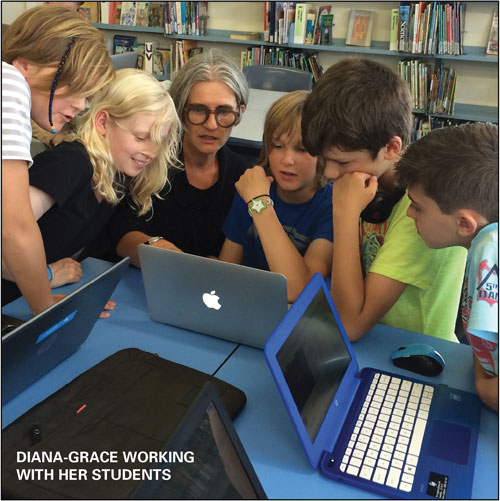 Wellington teacher Diana-Grace Morris makes time for her students to design games in class because it fosters a unique interaction among them she doesn’t see in any other learning activities, writes Wayne Erb.
 Got the best road safety game idea? Gather your team, make it happen and win!