Key Competencies for the future

Last week I attend a conference put on by Greater Wellington Regional Council with @NZTAeducation


Below are some thoughts from Rose Hipkin's plenary

As always, stunning provocations from Rose.

Rose started her plenary by asking us...

Think of an an episode from your own teaching experience where you saw " lifelong learning" in action...
The instant silence in the room was not lost on us. This question stopped us in our tracks. We immediately needed to think and think hard.

My group shared examples like...
Things that interrupted us. Things that jarred us. Shocked us. Woke us up.

I then wondered if it was possible that
The conditions to enable life long learning... Perhaps, might be, Situations where certainty & uncertainty were in balance.

Rose then went on to discuss the take home messages. 
(a bit like serving dessert first at a dinner party!)


(I think about this...

The word 'take' has a jarring effect on me.

Is this the  language that supports us to work with a future focussed lens? I think this is worth us thinking about. Is 'taking' an action we can keep doing?

So, when I'm  wondering what does collaboration look, feel and sound like. I'm not sure 'take' is assisting in the conditions for collaboration to play out.  Has any one else thought about this? 

Perhaps... What might I contribute to the message today? If we asked ourselves this we might then need to think a bit harder than usual. 

So I'm listening to Rose and I"m thinking about how the Key Competencies contribute to teaching for complexity. That it is through the key competencies that curriculum knowledge might shift from static to action. Where curriculum knowledge is invited to become a verb. Where it's not what we know, but what we can do with what we know. To do this we need the capabilities.)


Rose discussed the following points:

The Key competencies are capabilities for life long learning.

Key competencies are critical thinking frameworks for everyday.

Key competencies are the lens to bring the 'So What' into our thinking.

The elephant in the room is - CONTENT.

It's not how we select content but how we develop content.

Rose asked us all to make sure we read:

David Perkins book Future Wise. 


Rose discussed David Perkins thoughts on the conditions for rich learning experiences

3 agendas that work against rich learning experiences 1.Push for achievement 2.Focus on knowing all the stuff 3.Focus on expertise Perkins

This does not mean the situation is hopeless, but we do need to think hard and dig deeper to understanding the role each point activates.

Rose finished her plenary asking us - that if nothing else...
Where in our planning and implementation of teaching and learning are the rich connections?
Where is the level of challenge?
How does each of these make a contribution to our future?

At the end of the day..
Weather you take something home..
contribute some thing to the space...

The one action that must happen is...
Re imagine the teaching, re imagine the learning so it is meaningful and future focussed for all students.


Game design creates collaborative ‘hum’

The following post has been copy pasted straight from  Interface Online Magazine

Game design creates collaborative ‘hum’

diana_graceWellington  teacher Diana-Grace Morris makes time for her students to design games in class because it fosters a unique interaction among them she doesn’t see in any other learning activities, writes Wayne Erb.
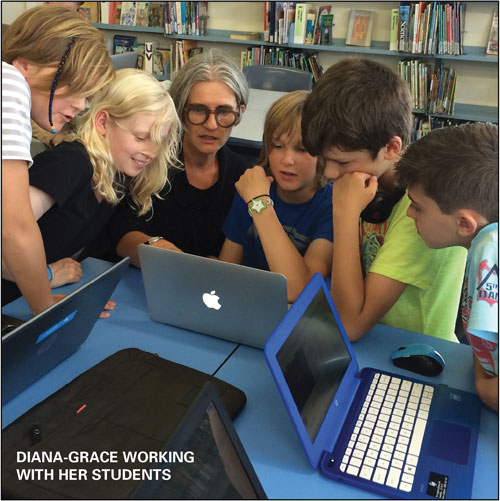
There is an energetic rise and fall of sound when a class of Year 7-8 students work together to design games, says teacher Diana-Grace Morris.
“When students are creating games, the classroom soundscape moves quickly from silent to slow talking, then to loud, fast talking. Then it drops down to silent and re-loops. I refer to this soundscape as the ‘hum’ and it reflects a real learning hum that is going on.”
Diana-Grace is Assistant Principal at Ridgway School in Wellington. She blogs and tweets about future-focused learning and is in the reference group of teachers for the NZ Transport Agency’s Game Design Competition (see sidebar).

Process of creation

She believes game-based learning can promote ‘strong collaboration’ amongst students – something that is evident both in the outcome and during the process of creation.
“When my students make a new game, they are creating something that they could not create on their own, and to get that result, there is tension in the group – a lot of it. We need our students to experience these tensions, as that is when students are busy putting their key competencies into play.
“So, in order to move towards strong collaboration, you need to plan for how the key competencies can be firmly anchored into  the teaching and learning process.”
Diana-Grace says learning within a key competencies frame gives the class a way to explore future-focused learning. This focus can emerge through thinking and doing things in such a way that learning includes not just what a student knows, but what they can do with what they know. Collaborating with others is often critical to providing such rich opportunities for students.

Collaboration observed
During game design lessons, Diana-Grace has seen her students
  • highly engaged with the game design process;
  • negotiating different social/friendship groupings;
  • moving around the classroom to check each other’s work;
  • playing each other’s games and giving fast, critical feedback;
  • improving their game design quickly as they gain feedback and build their understanding of what makes games work well; and
  • keen to support others in learning coding skills to achieve a particular functionality.
For more from Diana-Grace see her blog at exploriosity.blogspot.co.nz


Certainty and uncertainty
“After seeing the games my students are creating, and the experiences they have had with social good games, I think it is possible for game-based learning to be a vehicle for thinking about the present and future differently,” she added.
“For myself, to teach, act, and think differently requires the teaching and learning space to oscillate between certainty and uncertainty.
“The apparent certainty of curriculum knowledge gets applied into a variety of certain and uncertain spaces. An uncertain space might be a context that the class has not previously understood, where we are unsure what to do, but this uncertainty provides an opportunity for new learning to take place.
“I create spaces for my students to design games in class because I observe the students relating to each other in ways I haven’t seen or heard in other learning experiences.”  
Wayne Erb is a freelance writer.

Game Design Competition 2016

nzta-gameGot the best road safety game idea? Gather your team, make it happen and win!
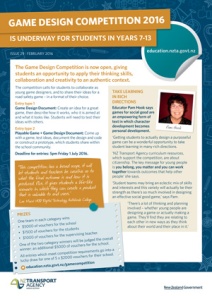
Organised by the NZ Transport Agency, the Game Design Competition 2016 is open to Year 7-13 students and runs through Terms 1 and 2. It provides an authentic context for students to design digital or non-digital games about road safety.
There are two categories:
Game Design Document 
Or Playable Game + Game Design Document. 
Entries are by teams of three or more. The competition website includes game design tasks linked to curriculum resources across several learning areas.
For more see centre pages or go to education.nzta.govt.nz/gamecompetition

#EdBlogNZ Leap Day Challenge 29th February


It comes around only once every 4 years. On February 29 an bonus EdBlogNZ challenge has been set. It's time to take a LEAP. It's time to stretch yourself and create an audio or video post about a passion of yours. You can upload a video to YouTube (or similar) or create an audio post using SoundCloud (or similar) and embed it into a blog post. Take the extra step of adding a transcription of the audio/video to make it more accessible.


Monday 29th February 2016

9:30am - 10:30am

Social Skills / PB4L and Game Design

I like...
I wonder...
What if...

Every Monday the class has an hour of Social Skills / PB4L and Game Design. 

We are currently working on a  Road Safety Game Idea it is part of a Game Design Competition, run by @NZTAeducation

I caught this conversation as I walked past a group of students today.


Thinking is not optional.


Why title a blog post 'thinking is not optional?'
I mean, many of us are educators and we get paid to think. Don't we? Do we?

I attended #educampwelly  yesterday. 

Yesterday  I had the absolute pleasure of being in conversations with educators from around Wellington. We were talking about Game Based Learning.  There was agreement amongst some teachers, that it is the school time table that stops them from being able to engage with Game Design in the classroom.

I've been thinking a lot about this. 

I know it's a reality - many of us in classrooms are shadowed by an internal voice that whispers "so little time - so much to do". 

However, I realise I'm tired of this response.

Our role as educators is to think. This is not optional.

In New Zealand we are working with an outstanding future focussed curriculum document. 

Are we actually reading this document?

Game Based Learning, Game Design is simply another vehicle for us to think, do and act differently in our classrooms. 

It is our task to think and to think hard.

Future focussed teaching is about thinking - perhaps working with another teachers recipe, but not using exact quantities. - We are not cooks. We are chefs.

We are going for a slow cook. Ideas take time. Thinking 'how' with our time table takes time. However it is possible.

 We must think and we must think together.

I am reminded of Robert Kegan's work. He talks about the process required regarding  that which we are subject to - we need to make object.

 Is it possible this is a key skill towards developing conditions for change?

“Successfully functioning in a society with diverse values, traditions and lifestyles requires us to have a relationship to our own reactions rather than be captive of them. To resist our tendencies to make right or true, that which is nearly familiar, and wrong or false, that which is only strange.” 
― Robert Kegan


“At the simplest level, any particular expression of the immunity to change provides us a picture of how we are systematically working against the very goal we genuinely want to achieve.” 
― Robert KeganImmunity to Change: How to Overcome It and Unlock the Potential in Yourself and Your Organization


Simple Habits for Complex Times


Written by  Jennifer Garvey Berger and Keith Johnston

I have mentioned this book previously on this blog. 

I'm going to re read this book over the next couple of months. I'm going to do a slow read. The kind of read where you really sit with the flavours and wait in between chapters. I'm hoping to notice a deeper flavour.

I'm finding my self rethinking  the importance of asking different questions and the role different questions play in shaping feed back. I'm thinking this is more potent that I first thought. 

I am wondering how the ideas in this book can inform my teaching Inquiry during 2016. At first glance things like 'teaching Inquiries'  are treated as complicated. Almost as if they were a puzzle that with the right amount of knowledge and skills we will be able to solve. However, my thinking has shifted. Teaching Inquiries are complex. 

Over the next few weeks, as I re read,  I will add my thinking to this blog post.

See link below:

Dr Jennifer Garvey Berger and Dr Keith Johnston - Simple Habits for Complex Times


Chapter 1 - Leading the possible

Chapter 2 - Engage with complexity, but keep it simple

Chapter 3 - Say What you Think, Listen to the Ways You Might Be Wrong 
The title of this chapter in itself is a reason to read this book!

Chapter 4 - 

Chapter 5 - 

Chapter 6 - 

Chapter 7 - 

Chapter 8 -

Inspirational bloggers

#EdBlogNZ Challenge WK 2

3. If at Ulearn - Find 2 bloggers you admire, shake their hand and take a selfie with them to post on your blog. If you’re feeling really generous buy them a coffee! Write about it too!


I walked into Permission 2 Play.
I registered, turned around and hey -  three bloggers almost standing in a row!
Bloggers who inspire me...
IMG_0179.jpg
Rachel Bolstad @shiftingthinkng
Rachel is my thinking about thinking about thinking about thinking and thinking about gaming chum. It’s all about the game, it’s all about the play, it’s all about the rethinking of the teaching and learning landscape.
IMG_0178.jpg
Marianne Malmstrom @knowclue
Marianne dives in and out of tweets that I’m super inspired and excited about. Conversations that inspire me seriously influence my next action. Marianne is about action and making the learning humm. So as you might imagine I’m so there.
IMG_0248.JPG
x-ray bex @paradisecreated
Becs is like my Welly Y 7 / 8 Bestie. We really cook up a storm when we are within wifi reach and face to face don’t get me started. Becs is one stunning educator. Two words to describe Becs. Grit and Style!

Moores Law - act and do different

#EdBlogNZ Challenge WK 2


2.  Find a blog post you have written in the past. Consider whether your thinking on the topic is the same or different and blog about why your thinking has changed or expand on your original ideas.
At Ulearn15 David Seymour talking about the importance of #MooresLaw and the vital role of teachers as disrupters. During David's talk I started thinking about a past blog post on Moores Law
I wrote this blog post (see below) almost two years to the day.
I am struck by how relevant this is - right now in regard to the things I’m thinking about.
It is from my thinking around Moore’s Law that propels my sense of “slow cooked - urgency” I”m writing my reflections in green.


Conflict, Change, Ideology, Innovation


A Perennial Question:
Q: What is going to disrupt us enough to interrupt the cyclic recapitulation, of linguistically dressing up, old ideas in a new way? (It hast' happened yet - buzz word bingo is alive)
A: Understanding the critically astounding relevance of Moores Law and ideas presented by Brynjolfsson and McAfee?


Two weeks ago (two years ago!)I was with a group of classroom teachers discussing the book


“Race Against the Machine is a portrait of the digital world – a world where competition, labor and leadership are less important than collaboration, creativity and networks.”


Suggests that with exponential growth and development of digital technologies sits alongside, in fact has caused, the increase in unemployment.


In Brynjolfsson and McAfee's words, "The root of our problems is not that we’re in a Great Recession, or a Great Stagnation, but rather that we are in the early throes of a Great Restructuring."

Moores Law maintains that computing power doubles every two years. The exponential growth looking like an enourmous J curve!


To grasp the full picture of exponential growth Jane Gilbert talked us through a story which illustrates this outrageous growth. (This activity is really powerful and well worth doing)
Ray Kruzweil 's story.


"In one version of the story, the inventor of the game of chess shows his creation to his country’s ruler. The emperor is so delighted by the game that he allows the inventor to name his own reward. The clever man asks for a quantity of rice, to be determined as follows: one grain of rice is placed on the first square of the chessboard, two grains on the second, four on the third, and so on, with each square receiving twice as many grains as the previous square.


“The emperor agrees, thinking that this reward is too small. He soon sees, however, that the constant doubling results in tremendously large numbers. The inventor winds up with 264-1 grains of rice, or a pile bigger than Mount Everest. In some versions of the story, the emperor is so displeased at being outsmarted that he beheads the inventor.”


That tale is bracing enough, but there’s a kicker: The most profound effects of the doubling phenomenon aren’t felt until you reach the second half of the chessboard."
Brynjolfsson and McAfee, believe that we are only just entering the second half of the chess board!


Jane gave us a chess board and rice to really see this idea play out.


I awoke the following morning:
My first thought was Really?
Then I realised I was seriously unsettled.
So unsettled that it has taken me two weeks to write this post. (And 6 days to reflect on it!)
I think about the students in my classroom and then I know I have the dreaded question...


Q:  Am I teaching for unemployment?
I'm teaching for my students to have the capacity and skills to create and be ready to engage with an ubiquitous future. I continue to find the idea of teaching for unemployment difficult to accept.


Following this question...
Andy Hargreaves spoke at an IB conference #IBAEM2013 in the Hague asking...
Q: Are we teaching for employment or citizenship?
I completely agree we are teaching for citizenship.


Thanks to @catherinecronin  (Who's work and research interests are online and open education, digital literacies and social media in education.)
I tweeted and tumbled over,
Selwyn, N & Facer, K's new publication.


I have returned to this publication 6 times in the last four years. Yes really! The best thing is the  Ministry of Education Library has a copy.
The chapter I read suggests that it is time we looked at technology and education in a very different way.  In doing so it is possible to race not against but with the Machine!


" .. instead of being distracted by our own (often privileged) personal experiences of digital technology, this book  starts from the premise that we need to work instead towards understanding and acting on educational technology in terms of its complicated and often unjust connections to the larger society."  Selwyn and Facer pg 4


Selwyn and Facer suggest we need to engage with a critical study of Educational Technology
1.  Move away from technology being a means to an end as this does not ask us to question or understand the 'full nature and value of education'.
2. "..disrupt the deterministic assumption that technologies possess inherent qualities and are capable of having particular predetermined and predictable 'impacts' or 'effects' on learners, teachers, wider society." pg 8

Selwyn and Facer are able to show that the relationship between education and technology is a historical and present day narrative about Conflict, Change, Ideology, Innovation.  
At present , in schools, I do not think we have even touched the edges on these ideas.


A few days ago @FDHarrington (A Secondary School Physics teacher) asked the question in his blog:
How do we convince others about the need for change?
Facer tweeted a suggestion, plain and simple.
"Start acting where you can."


Q: What does acting look like?
A: It is the process of doing. Be the change you want to see, include as many others networks as possible as diverse as possible. Have an open hand. Engage in activities that motivate creativity, change and foster strong collaboration towards idea improvement and the building of knowledge. Since writing this blog post I have read Jim Daytor’s work. 
Daytor suggests.
"Any useful statement about the futures should appear to be ridiculous."
- Jim Dator


Q: What does acting sound like?
A: It is the process of speaking up. If opportunities arise where assumptions can be questioned step in, up and out! Be reflective, speaking ethically and critically. Know your research, be the research and share! It is possible that acting different needs to be so different that we feel unsettled. When our puse beats faster. That feeling when perhaps we are not ready. That may be the time to act.